
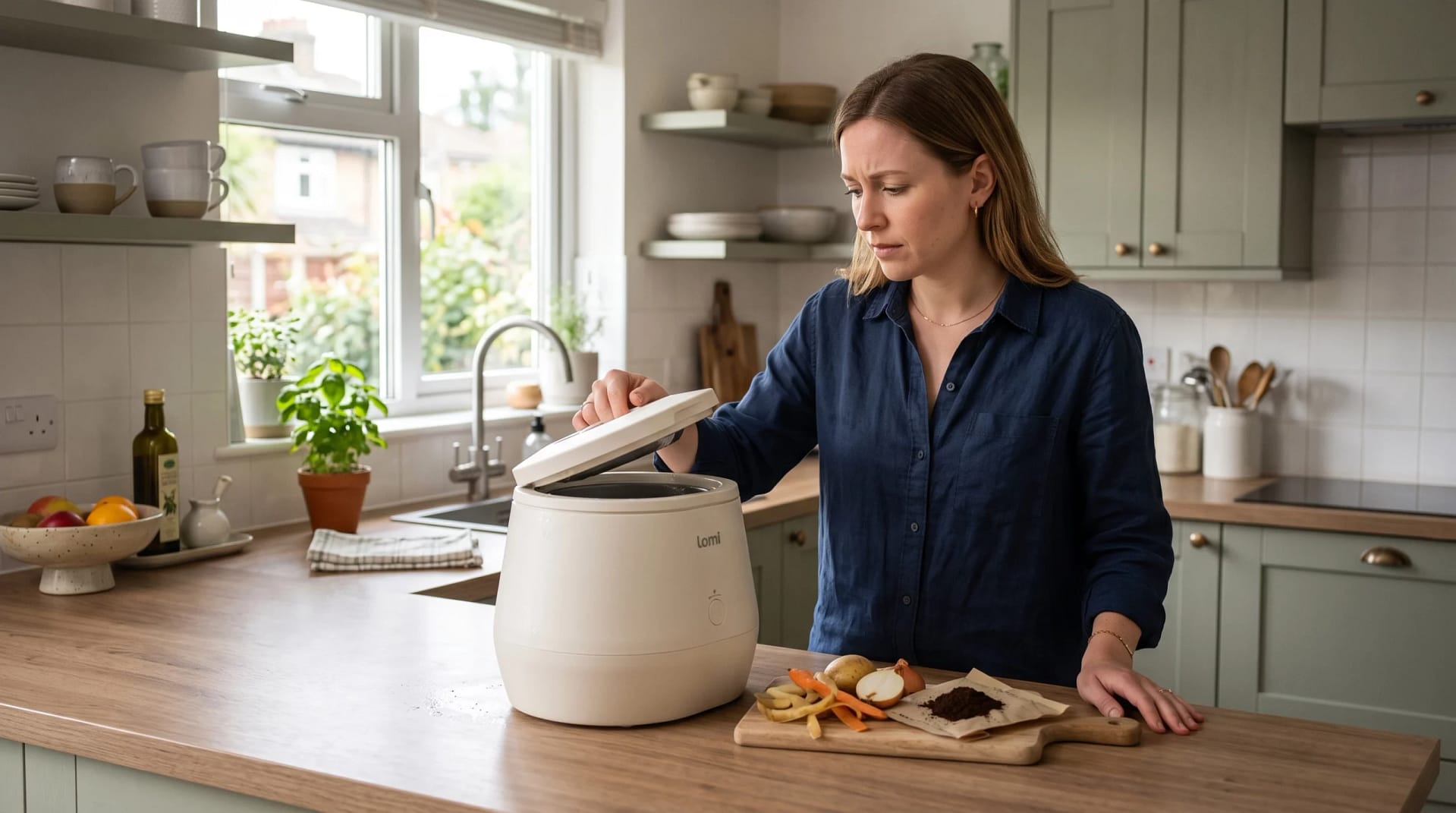
An indoor composter is supposed to make dealing with food scraps easier, not turn your kitchen into an olfactory science experiment.
If your indoor composter has developed an unpleasant smell, don’t panic. Odour is usually a sign that something about the composting process needs attention, rather than a reason to abandon indoor composting altogether.
The right solution depends on the type of indoor composter you use. A heated electric composter, food-waste dehydrator, bokashi system and traditional composting system all handle food scraps differently, so the same smell can have very different causes.
In this guide, we’ll look at the most common reasons why an indoor composter smells, how to identify the problem and what you can do to fix it.
Quick answer: Why does my indoor composter smell?
The most common causes of an indoor composter smelling include:
- Too much moisture
- Not enough airflow or oxygen
- Too many food scraps added at once
- Food scraps sitting too long
- Incorrect carbon-to-nitrogen balance
- Meat, dairy or other unsuitable materials in a system that isn’t designed for them
- A dirty bucket, lid or collection area
- A full or ineffective odour filter
- Incorrect settings on an electric composter
- A bokashi system that is not being sealed properly
The important thing is to identify the type of composter you have before trying to fix the smell.
First, what type of indoor composter do you have?
Indoor composters are not all doing the same job.
Electric kitchen composters
Electric composters generally use heat, drying, grinding and sometimes other processes to reduce food waste into a dry or semi-dry material.
- Whether the unit needs cleaning
- Whether the filter needs replacing
- Whether the chamber is overloaded
- Whether food is sticking to the inside
- Whether the drying cycle is completing properly
- Whether you’re adding materials outside the manufacturer’s recommendations
A mild food smell during operation may be normal for some machines. A persistent rotten or sour smell usually deserves investigation.
If you’re considering an electric model, our guide Electric Composters Explained: How They Work, Pros, Cons & Are They Worth It? can help explain what these machines actually do.
Bokashi composting systems
Bokashi works differently from conventional aerobic composting.
It uses fermentation rather than ordinary aerobic decomposition, so a sour, pickled or fermented smell can be normal.
However, a strong rotten smell can indicate a problem such as:
- Too much air getting into the bucket
- Not enough bokashi bran
- Food scraps being left exposed
- Excess liquid
- The bucket not being sealed properly
- The system being contaminated
For more detail, see our Bokashi composting guide.
Traditional indoor composting
If you’re using a small indoor composting system that relies on biological decomposition, airflow and moisture become particularly important.
Too much moisture combined with poor aeration can encourage anaerobic decomposition, which is one of the classic causes of unpleasant compost odours.
1. Too much moisture
One of the most common causes of a smelly composting system is excess moisture.
Food scraps naturally contain a lot of water. Fruit, vegetables, coffee grounds and cooked foods can quickly make a small composting container wetter than intended.
When material becomes excessively wet and compacted, air movement can decrease. That can create conditions where unpleasant odours develop.
What to do
Depending on your system, you may be able to:
- Add suitable dry carbon-rich material
- Drain excess liquid if your system is designed for it
- Avoid adding large quantities of very wet food at once
- Mix or aerate the material if your system allows it
- Allow an electric composter to complete its full drying cycle
Don’t automatically add dry material to every indoor composter, though. Always follow the instructions for your particular system.
2. There isn’t enough airflow
Aerobic composting needs oxygen.
When food scraps become tightly packed, especially when they’re wet, air can’t move easily through the material.
The result can be a shift towards anaerobic decomposition, which can produce unpleasant smells.
This is particularly relevant to systems that rely on conventional biological composting.
The fix
If your composter is designed to be mixed or aerated:
- Gently loosen compacted material.
- Break up large clumps.
- Avoid compressing scraps into the container.
- Add suitable dry material if your system calls for it.
- Make sure ventilation openings aren’t blocked.
If your unit uses a motor, fan or other mechanical process, don’t dismantle it or interfere with ventilation components unless the manufacturer specifically instructs you to.
3. You’ve added too much food at once
Even a good composting system has a processing capacity.
Adding a large amount of food waste at once can overwhelm the system, particularly if the scraps are wet or difficult to break down.
- Excess moisture
- Compaction
- Slow processing
- Increased food odours
Try this instead
Feed your system according to its recommended capacity.
If you regularly generate more food waste than your current composter can comfortably handle, it may be worth looking at a larger system or using more than one waste-management method.
Our Indoor Composter Finder can help you compare options based on your kitchen and household needs.
4. Food has been sitting too long
Sometimes the culprit is surprisingly simple: old food scraps.
Food waste can begin producing unpleasant odours before the composting process has properly got going, especially in a warm kitchen.
- Onion scraps
- Fish
- Meat
- Dairy
- Cooked foods
- Very ripe fruit
- Large quantities of leftovers
The solution is usually to process or transfer the material according to your system’s instructions rather than allowing scraps to accumulate indefinitely.
5. Your composting balance is off
For systems that rely on biological composting, the balance between carbon-rich and nitrogen-rich materials matters.
Food scraps are generally nitrogen-rich and wet. Composting systems may need suitable carbon-rich material to help balance moisture and decomposition.
- Dry leaves
- Untreated shredded paper
- Plain cardboard
- Dry plant material
- Other carbon materials recommended for your particular system
But again, not every indoor composter requires additional carbon material.
An electric food-waste machine is fundamentally different from a conventional composting system, so don’t treat every indoor composter as though it were a miniature outdoor compost heap.
6. Your odour filter needs attention
If your indoor composter uses a charcoal or activated-carbon filter, it may eventually become less effective.
This is an easy one to overlook because the machine itself may still appear to be working perfectly.
- How long the filter has been installed
- The manufacturer’s recommended replacement schedule
- Whether the filter is positioned correctly
- Whether the filter is clogged or visibly dirty
A worn-out filter can turn an otherwise well-behaved kitchen appliance into a surprisingly effective aroma distributor.
Don’t forget the lid
Food residue can also accumulate around:
- The lid
- Seals
- Edges of the processing chamber
- Collection containers
- Drainage areas
Regular cleaning can make a substantial difference.
7. The composter itself needs cleaning
Sometimes the compost isn’t the problem.
The container is.
Small amounts of food residue can build up in corners and around seals. Over time, those leftovers can smell even when the main composting process is working correctly.
- The inside of the bucket
- The lid
- Rubber seals
- Food-contact surfaces
- Collection trays
- Liquid reservoirs
- Areas around vents
Use only cleaning methods recommended by the manufacturer, particularly for electric appliances.
8. You’re adding something your system doesn’t handle well
One of the easiest ways to create problems is to assume that because something is biodegradable, it automatically belongs in your indoor composter.
That’s not necessarily true.
Different machines and systems have different accepted materials.
For example, some electric composters can process a broad range of food waste, while others have restrictions. Bokashi systems also have their own operating principles.
Before adding something questionable, check the manufacturer’s instructions.
Our Compostability Checker can also help you work out what commonly compostable materials may be suitable for composting, while remembering that compostability and compatibility with a particular indoor composter are not always the same thing.
9. Your bokashi bucket smells rotten
If you use bokashi, don’t confuse a normal fermented smell with a failed batch.
A healthy bokashi bucket can have a distinctive acidic, fermented or pickled smell.
A strong rotten smell, however, can indicate that the process has gone off course.
Check these basics
Bokashi relies on fermentation, so repeatedly opening the container and allowing air in isn’t ideal.
Follow the instructions supplied with your system.
Removing air pockets can help the fermentation process.
Follow your bokashi system’s instructions for dealing with the liquid.
If the contents have developed a distinctly rotten smell rather than the expected fermented smell, review the system’s instructions before continuing.
10. Your electric composter smells during operation
A little food smell isn’t necessarily a sign that something has gone wrong.
Heating and processing food scraps can release noticeable aromas, particularly when you’re processing strong-smelling foods.
Fish, onions, garlic and some cooked foods can make themselves known.
However, if the smell is strong, persistent or noticeably different from normal operation, investigate.
- Is the unit overloaded?
- Is the processing cycle completing?
- Is the filter due for replacement?
- Is food residue stuck inside?
- Are you adding materials outside the manufacturer’s recommendations?
- Does the machine display an error or warning?
If the appliance is behaving abnormally, stop using it and consult the manufacturer’s guidance rather than attempting an improvised repair.
What does the smell actually tell you?
The type of smell can sometimes provide a useful clue.
| Smell | Possible cause |
|---|---|
| Rotten or sulphur-like | Poor aeration, excessive moisture or anaerobic decomposition |
| Sour or fermented | May be normal in bokashi |
| Strong food smell | Fresh scraps, cooking residues or strong-smelling foods |
| Musty | Damp material or insufficient airflow |
| Burnt or electrical smell | Stop using the appliance and investigate immediately |
| Persistent smell from a machine | Filter, cleaning or processing issue |
These are general troubleshooting clues, not diagnoses. Your particular composter’s design and manufacturer’s instructions should always take priority.
How to stop your indoor composter smelling
A little prevention can save a lot of nose-wrinkling later.
1. Don’t overload it
Stay within the manufacturer’s recommended capacity.
2. Follow the accepted-food list
Don’t assume every food scrap belongs in every system.
3. Keep moisture under control
Particularly important for systems that rely on aerobic decomposition.
4. Clean regularly
Don’t wait until there’s an odour problem.
5. Maintain filters
Replace filters according to the manufacturer’s instructions.
6. Process food waste promptly
Don’t let scraps sit around unnecessarily.
7. Keep the system operating as designed
If it needs ventilation, don’t block it. If it needs a sealed lid, keep it sealed. If it needs regular draining, follow the instructions.
Can you put a smelly indoor composter outside?
It depends on the system.
Moving a problem outside doesn’t necessarily solve the underlying issue, and some electric composters are designed specifically for indoor use.
Before relocating a unit, check:
- Manufacturer instructions
- Weather and moisture exposure
- Electrical safety
- Ventilation requirements
- Temperature limitations
For an electrical appliance, never place it outdoors unless it is specifically designed and approved for outdoor use.
When should you stop using your composter?
Most unpleasant food-waste smells are troubleshooting issues.
However, some smells should not be ignored.
If you notice a burning, melting-plastic or electrical smell, stop using an electric composter and disconnect it safely if appropriate. Check the manufacturer’s safety instructions and contact the manufacturer or a qualified technician if necessary.
Likewise, if the appliance is overheating, producing smoke, repeatedly failing or showing an error condition, don’t keep running it simply because you hope the smell will disappear.
Food waste is one thing.
An appliance trying to become a smoke machine is another.
The bottom line
A smelly indoor composter usually has a reason.
For biological composting systems, too much moisture, poor airflow, compaction and an unsuitable balance of materials are common areas to investigate.
For electric composters, filters, cleaning, overloading, processing cycles and unsuitable materials are more likely places to start.
For bokashi systems, a fermented smell can be normal, while a distinctly rotten smell may indicate that the process needs attention.
The key is not to treat every indoor composter the same. Understand how your particular system works, follow its instructions, and troubleshoot the specific problem rather than guessing.
And if you’re still deciding which type of indoor composter is right for your kitchen, explore our Indoor Composter Finder and other CompostPulse tools before buying.
Frequently Asked Questions
Why does my indoor composter smell bad?
An indoor composter can smell because of excess moisture, poor airflow, overloading, old food scraps, unsuitable materials, inadequate cleaning or a filter that needs replacing. The exact cause depends on the type of composter you use.
Should an indoor composter smell?
Some odour can be normal, particularly when processing strong-smelling foods. Bokashi systems also naturally have a fermented smell. However, a persistent rotten, burning or unusual smell should be investigated.
How do I stop my indoor composter from smelling?
Keep the system clean, avoid overloading it, follow its accepted-food list, maintain any filters and control moisture where appropriate. For biological systems, adequate airflow is also important.
Why does my bokashi bucket smell rotten?
A rotten smell can indicate that the bokashi fermentation process isn’t progressing correctly. Check that the bucket is sealed, enough bokashi bran is being used, food is being pressed down and excess liquid is being managed according to the system’s instructions.
Why does my electric composter smell?
An electric composter may smell when processing strong foods, but persistent odour can indicate a dirty chamber, saturated filter, overloading, unsuitable materials or an incomplete processing cycle. Check the manufacturer’s instructions for your model.
Can I add baking soda to my indoor composter to remove smells?
Don’t add baking soda or other odour-control products unless your composter’s manufacturer recommends them. Adding an unapproved material can interfere with the system or potentially affect its operation.
Is a smelly indoor composter dangerous?
A food-waste odour does not automatically mean that a composter is dangerous. However, a burning, electrical or melting-plastic smell from an electric appliance is a reason to stop using it and follow the manufacturer’s safety guidance.
How often should I clean my indoor composter?
Cleaning frequency varies between systems. Follow the manufacturer’s maintenance schedule and clean food-contact areas regularly rather than waiting until unpleasant odours develop.
Take Your Composting Further
Discover free composting tools designed to help you compost with confidence. Check compostability, troubleshoot common issues, and find practical solutions for a more sustainable home.